USTH SVNCKH 2026Consolation Prize
Reading cracks through vibration
A student research portfolio combining ANSYS modal analysis with Random Forest models to diagnose faults in aircraft engine fan blades.
ResearchersBùi Nhật Minh · Nguyễn Hoàng Minh
SupervisorDr. Bùi Quang Thành
InstitutionUSTH, Hanoi

Signal0.131%median shift
Dataset55,350readings
Modes01-10frequency features
01
Research question
From a subtle signal
to a useful diagnosis.
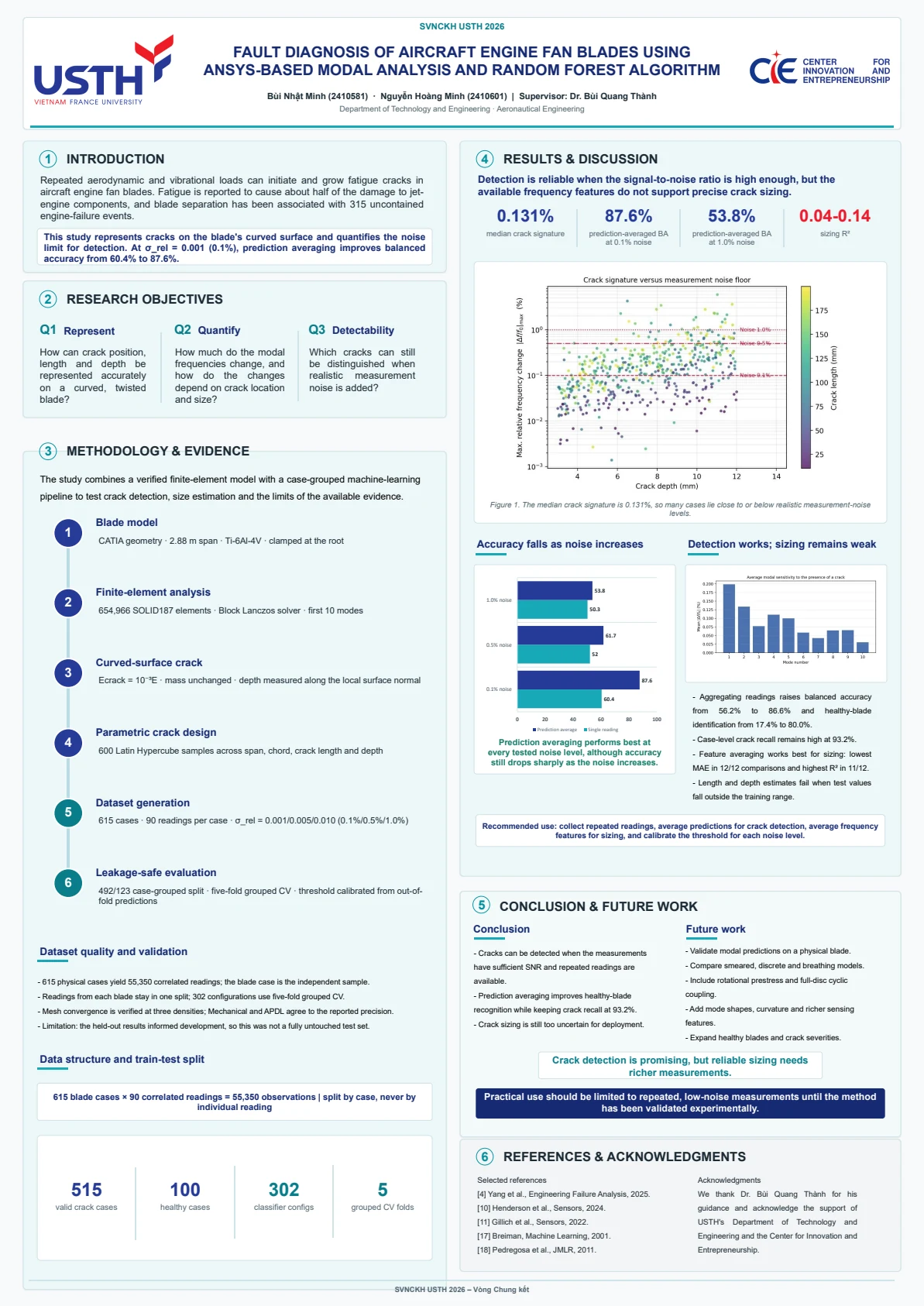
Can changes in a blade’s first ten natural frequencies distinguish a healthy blade from a cracked one-and support localisation and sizing?
The challenge is scale: on a full-size blade, many crack signatures are comparable to realistic measurement noise.
Q11
Represent
Model crack position, length, and depth correctly on a curved, twisted blade.
Q22
Quantify
Measure how each crack geometry changes the first ten natural frequencies.
Q33
Detect
Find which cracks remain distinguishable after measurement uncertainty is introduced.
02
Method · Connected pipeline
Physics in.
Evidence out.
Every stage feeds the next, while the physical blade case remains the independent sample throughout evaluation.
01CAD
Blade model
CATIA geometry, Ti-6Al-4V material, and a fully clamped root.
02FEA
Mesh verification
654,966 SOLID187 elements; convergence checked at three densities and against APDL.
03Physics
Crack representation
Local stiffness reduction with depth measured along the curved surface normal.
04Dataset
Case generation
600 Latin Hypercube samples spanning position, length, and depth; 515 valid cracks.
05Signal
Noise modelling
Three Gaussian relative-noise levels and repeated readings for realistic evaluation.
06ML
Grouped evaluation
Case-grouped split and five-fold grouped cross-validation prevent reading-level leakage.
CATIA V5ANSYS 2024 R1PyMAPDLPythonscikit-learn
03
Results · Operating boundary
Detection works.
Sizing does not-yet.
Repeated low-noise measurements improve classification, while frequency-only features remain too weak for precise crack sizing.
Prediction averaged across all 90 readings per blade case.
Case-level recall at the calibrated safety-first threshold.
Trade-off retained while prioritising missed-crack risk.
The report explicitly rejects deployment for reliable sizing.
Balanced accuracy by noise level
Averaging helps most when the signal is clean.
At 0.1% simulated noise, prediction averaging increases balanced accuracy from 60.4% to 87.6%. The advantage narrows quickly as noise rises.
Single readingPrediction average
050100%
0.1%noise
0.5%noise
1.0%noise
04
Evidence & limitations
The blade case-not the reading-is the sample.
Correlated readings never cross splits. That design decision makes the reported performance substantially more credible.
Numerical evidence
Simulation-based results have not yet been validated on a physical fan blade.
Healthy diversity
Healthy cases are noisy realisations of one baseline, not independent blade geometries.
Model scope
The clamped blade at rest omits rotational prestress, coupling, mistuning, and crack breathing.
Evaluation caveat
A future untouched simulation batch is needed for a strictly unbiased estimate.
05
Academic recognition
Consolation Prize
USTH SVNCKH 2026
The project received one of two Consolation Prizes in its evaluation panel. The university-wide competition featured 27 projects evaluated across three panels.
This states the official award category without implying an overall fourth-place ranking.USTH2026Student research
06
Research artifacts
Inspect the complete evidence.
The 20-page report records the assumptions, dataset, grouped evaluation and limitations. The A0 poster presents the competition-ready summary.
 Open A0 poster ↗
07
Selected references
Grounded in structural health monitoring and supervised learning.
- Yang et al. - Engineering Failure Analysis, 2025
- Henderson et al. - Sensors, 2024
- Gillich et al. - Sensors, 2022
- Breiman - Random Forests, Machine Learning, 2001
- Pedregosa et al. - Scikit-learn, JMLR, 2011